

To store a Christmas wreath without flattening its front, choose a container that holds its prepared outline and deepest decoration without pressure when closed. A rigid box gives you a defined cavity; a soft bag needs its own uncompressed space; hanging storage needs a support intended for that wreath and storage system. The best choice is the one that fits both the wreath and the place where it will stay.
Start with the finished shape you want to preserve. HOYECHI’s design perspective is that the front is the main viewing face, while the rear fixings should remain orderly. That does not mean every part of the back can carry a load. Bells, bow loops and curled accents need room around them, and rear wiring must not become a packing support.
Choose the storage method before buying the container
A package labelled for a particular wreath size does not tell you how much space remains beneath its lid. Use this comparison to decide what you need to inspect, then check the actual container.
| Method | When it can work | What to check before closing |
|---|---|---|
| Sound original carton | The original inserts are intact and the wreath fits in its permitted storage configuration. | Do not force a fully shaped wreath back into a factory shipping arrangement. Check the carton, inserts and the space above the front. |
| Rigid storage box | You need a defined space around a bow or other projecting decoration. | Check the narrowest inside width and depth. Tapered sides, ribs and the underside of the lid can reduce usable room. A rigid shell is not a promise that it can be stacked. |
| Soft wreath bag | You have a shelf or separate space where the bag will not be squeezed. | The zip must close without drawing fabric tightly across the front. Flexible fabric is a cover, not a rigid cavity that keeps other objects away. |
| Intended hanging storage system | You have vertical space and a suitable system for the wreath. | Use only the intended support point and compatible hanger or internal-hook bag. Leave the front clear of adjacent items; do not hang from the bow, bulbs or foliage. |
Check the inside space and the closing path
The useful question is not “Does the wreath fit through the opening?” but “Does it still have room after the lid or zip closes?” For the meaning of frame and outer dimensions, see how Christmas wreaths are measured. Then apply that information to the wreath as you will actually store it.
- Prepare the permitted storage shape. Leave fixed decorations in place. Fold or separate parts only where the instructions for that exact model allow it.
- Check the complete outline, including sideways berries, curled accents and bow tails. Then check the front-to-back depth at the furthest projection; the thickest part may not be the green ring.
- Compare that shape with the usable interior, allowing for inserts, tapered walls, hinges, lid ribs and the zip path. Exterior dimensions and a nominal wreath diameter cannot settle this comparison.
- Place the wreath gently in its supported position and bring the closure toward its normal closed position. If the lid meets a bell, the bow loops flatten or the zip pulls foliage inward, stop. Change the arrangement or container instead of using the closure to compress it.
A side view makes the missing space visible

A box can be wide enough yet too shallow. In the diagram, the support also occupies space, so the full outside height of the box is not available to the wreath. The closed lid must leave the front undistorted. The drawing does not prescribe a support material or prove a particular product/container combination.
Protect the display face without trapping the back
For a box arrangement that allows the wreath to rest securely, face-up storage can make it easier to see whether the front is clear. Position it using suitable frame or rear areas described by its instructions; do not rest it on a battery box, plug, loose wire or projecting fixing. Do not fill the centre with accessories that can shift into the bells or bow.
Keep loose accessories in a separate compartment or labelled pouch that cannot press into the wreath. Keep the model name with them. This is especially useful when two similar wreaths use different controllers: a convenient place inside the box is not enough if those parts can move across the display face.
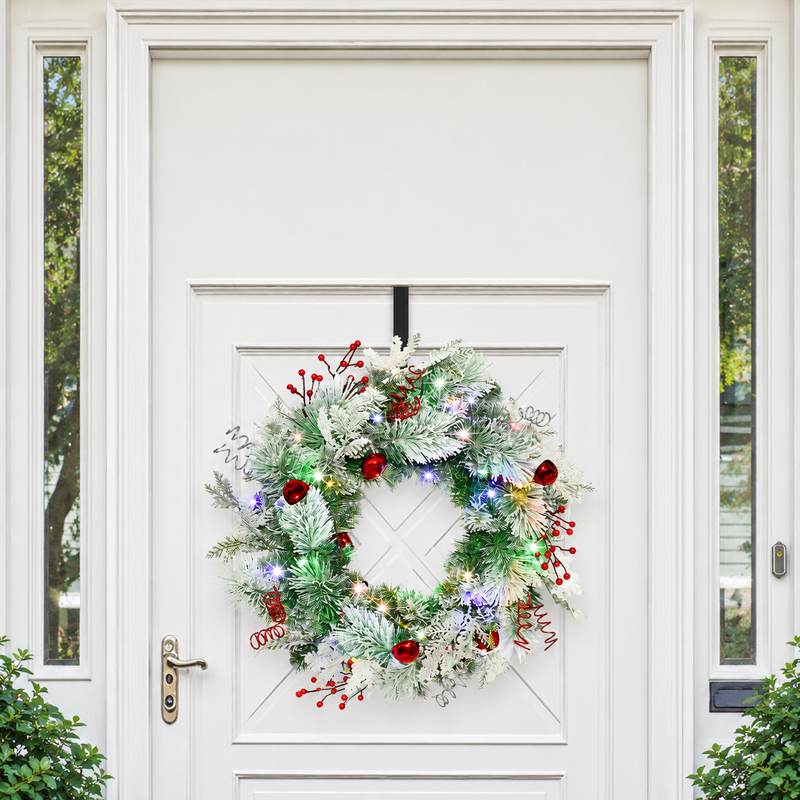
The HYC704 flocked wreath shown here illustrates why an outline alone is insufficient: bells and curled accents are part of the shape worth protecting. Its current care guidance calls for dry storage and removing batteries after the season. Apply that instruction to this model; check your own model’s instructions for its power components.

Keep integrated bows and lights with their intended assembly
Do not assume a large bow is removable because it makes packing awkward. On a lighted design, the bow can be connected to the lighting assembly. The HYC715-48 example has a lighted red bow, frame sections and fasteners; its care wording says not to crush the bow or pull the wires. That supports protecting the assembly, not inventing a disassembly sequence.
For a large or sectional wreath, use only the separation or folding that the exact model is designed for. Keep the correct fasteners with their sections without placing them against the front. If the instructions do not identify a storage fold, choose a larger container or suitable hanging system rather than bending the ring to fit.

Reserve space around the chosen container
A correctly sized bag can still be compressed between other boxes. A box lid can also become a shelf for unrelated items. Reserve a protected space and avoid loads on the wreath’s front; use one wreath per space as the simplest arrangement, or a system designed to keep several wreaths separated.
Choose a location that meets the model’s storage instructions and keeps the wreath dry before packing. “Garage” and “attic” are room names, not evidence of suitable conditions. For organising other large decorations alongside the wreath, use the separate guide to storing large outdoor Christmas decorations.
Plan for the next display—and the next purchase
Good packing protects the main form, but it does not promise that every tip will remain in its display position. When unpacking next season, follow the artificial wreath shaping guide to restore natural outward layers rather than repeating that process during storage.
When choosing another wreath, consider where both its finished display shape and its packed shape will fit. The outdoor wreath buying guide covers the display decision; browse HOYECHI wreaths and seasonal greenery with a storage plan for the decorated front, especially when choosing a prominent bow or bells.
Christmas wreath storage questions
Can I reuse the original box?
Yes, if it is sound and the wreath fits with the original or suitable intended supports. If closing requires pressing the decorated front down, the box does not fit that storage shape. Factory compact packing is not permission to force it back.
Is a bag with the same listed diameter automatically large enough?
No. The stated size may not describe usable inside depth, the opening or the zip path. Compare the complete prepared wreath with the actual interior, including the furthest bow loop and side accents.
Is a soft bag suitable for a large bow?
It can be if the bag closes loosely and has a protected space where nothing presses on it. If neighbouring items will squeeze it, choose a container that provides the needed cavity or relocate the bag.
Should the wreath lie face up?
That can work in a box when suitable parts support the wreath and the front remains clear. It is not a universal rule for all designs. Avoid resting it on wiring, a controller or a protruding decoration.
Can I hang it for the whole storage season?
Only with a hanging arrangement intended for the wreath and compatible storage system. A decorative loop or branch is not automatically a suitable support. Check both the wreath instructions and the hanger or bag instructions.
Can I put two wreaths in one box?
Do not place one directly on the other’s decorated face. Use separate protected spaces, or a system designed to keep them apart. A divider that merely transfers the upper wreath’s weight onto the lower bow does not solve the problem.
Should I remove a fixed bow?
Leave it attached unless the exact model’s instructions permit removal. Do not cut ties, undo unknown fixings or pull a lighted bow away just to use a smaller box. Allow space for its shape.
Do I need to take off all the lights?
No universal removal rule applies. Keep integrated lights in their intended assembly and follow the model instructions for disconnecting power and storing batteries or controllers. Do not pull wires to reposition the wreath.
Can I compress it if the factory shipped it compactly?
Do not use factory shipping compactness as a household repacking instruction. Only move or fold parts in the way permitted for that model. If the closure needs force, reassess the fit.
What if my large wreath will not fit any shelf box?
Check whether its design permits section separation. If it does, store the sections and their fasteners as instructed. Otherwise plan a larger protected location or an intended hanging arrangement; do not bend the ring to match a shelf.
Is a garage or attic a suitable place?
Check the actual location against the model’s storage instructions. A dry-looking room name does not establish its conditions throughout the storage period. Choose another space if the required conditions cannot be maintained.
Will careful storage remove the need to shape it next year?
No. Some tips or accents may still need gentle arranging after unpacking. Storage should protect the overall form and decorations; the separate shaping guide explains how to restore the display without treating the wreath as a flat ring.
Reference and image notes
For a broader comparison of storage formats, The Home Depot’s holiday storage guide also discusses wreath bags and hanging storage. Model-specific instructions take precedence.
The product images illustrate appearance. No real packing photograph or storage test was supplied for this guide; the side section is an original concept illustration.


