

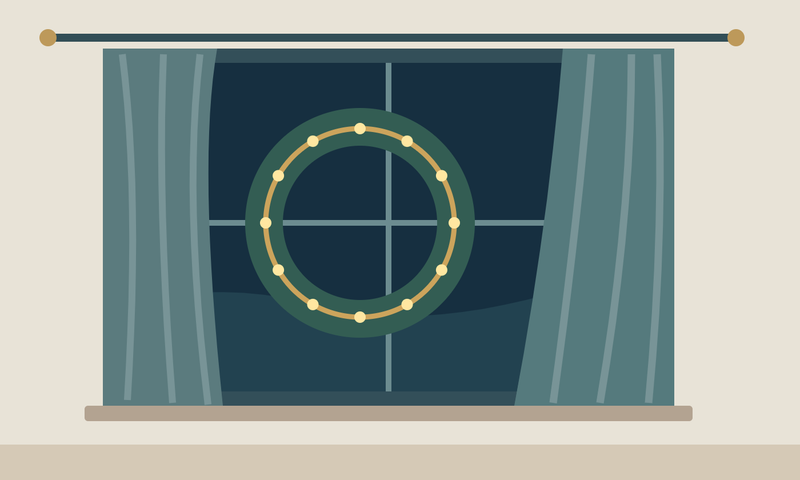
When choosing light up wreaths for windows, decide which decorated face you want to enjoy and what happens when you close the curtains. A wreath can look inviting from the street without offering the same view from your sofa. Lights visible from behind do not, by themselves, establish a finished decorative reverse.
Start with the room’s normal evening routine. A display that suits the hours before the curtains close may be exactly right; another household may want to enjoy its wreath throughout dinner. These are different preferences, not a competition to keep every decoration visible all night.
Three different meanings of “visible from both sides”
Visible light
You may notice lit points through or around the foliage. That observation tells you about the light you can see, not the arrangement of bows, ornaments or greenery on the other face.
A decorated reverse
This means the other side has a decorative treatment you can assess. Verify the exact model’s rear view; “pre-lit” describes included lighting, not two-sided decoration.
A useful household view
Even a documented two-sided design can be hidden by a closed opaque curtain. The product’s appearance and its position relative to your normal window treatment answer different questions.
Choose the face you want to enjoy
Ask whose first impression matters most at this window. If it welcomes visitors, the outward face may take priority. If the window belongs to the room where your family gathers, the room-facing details may matter more. You can also choose a design with a documented reverse that you like; you do not have to make both views identical.

What changes when the curtains close?
Think of the glass, wreath and closed curtain as separate layers. In a simplified arrangement, a wreath between glass and an opaque curtain is on the street side of that curtain: closing it interrupts the room’s view of the wreath. Put the curtain between glass and a room-side wreath, and it interrupts the street’s view instead. This is a viewing distinction, not permission to place a product in either position.
Which view does the closed curtain interrupt?
Layer order: outside toward room; left to right on wide screens, top to bottom on narrow screens.
A · Wreath on the window side of the curtain
- Outside
- Glass
- Wreath zoneChosen decorative face: toward outside
- Opaque closed curtain
- Room
The curtain interrupts the room-side view of the wreath.
B · Wreath on the room side of the curtain
- Outside
- Glass
- Opaque closed curtain
- Wreath zoneChosen decorative face: toward room
- Room
The curtain interrupts the outside view of the wreath.
Sheer fabric and partly open blinds produce different views, so assess your own usual setting rather than assuming every curtain behaves alike. Compare the plan before and after normal closure. Keep the privacy routine you want; choose another suitable display position if the wreath only works when you leave the window uncovered. An exterior wreath is also screened from the room by an opaque closed curtain.
Three sensible choices for one window
These are hypothetical household decisions, not customer installation stories.
An evening welcome
A family mainly wants visitors to see the decorated face before the curtains close. They accept that the reverse may be less decorative from indoors and that closing an opaque curtain ends their indoor view. The worthwhile result is a welcome they enjoy during the intended hours.
A wreath for the room
Another household spends its evenings with the curtains closed. It gives priority to a suitable room-facing display, accepting that people outside may not see it. The decision is about who enjoys the decoration, rather than adding another wreath to compensate.
Both views really matter
A third household wants appealing details on each face while the window is uncovered. It asks for the exact reverse and lit views before choosing a candidate. If the evidence is missing, it can wait or compare a documented alternative, without assuming that a hidden side must be poorly made.
Read the gallery for the view you actually need
Compare a daylight front image, an exact reverse image and lit views from the sides you care about. Close-ups answer a different question: what the visible decoration looks like. The HYC714-24 detail below shows flocked foliage and an ornament; it cannot establish an unseen rear finish. Both images here are appearance references, not proof of mounting arrangements or suitability for an exposed exterior window.

See the HYC706-24 product-gallery example and HYC714-24 front-detail example for their respective gallery views. Check the exact model’s stated location requirements separately.
Once you have chosen the viewing arrangement, compare wreath size with your chosen window area. Then browse HOYECHI wreaths and garlands, using the same front-and-reverse questions for each candidate.
Questions about light-up window wreaths
Does pre-lit mean a wreath is decorated on both sides?
No. It means lighting is included. A finished decorative reverse is a separate feature to confirm for the exact model.
If I can see lights from behind, is that enough?
It may be enough if that simple view is what you like. It does not tell you whether the reverse has the same foliage, bow or ornament arrangement.
Which way should the decorated face point?
Toward the view you have chosen to prioritize, provided the product’s permitted placement allows it. There is no single direction that serves every room and street equally.
Can I see an exterior wreath through closed curtains?
A closed opaque curtain interrupts that sightline. A sheer or partly open treatment is different; judge the setting you actually use.
Which extra image is most useful if the gallery only shows the front?
An exact rear view. If the after-dark appearance matters, also request a lit view from that same side rather than another front close-up.
Is a front-only decorated wreath a poor choice?
Not automatically. It can suit a display intended mainly for one direction. The issue is whether its visible side matches your expectations.
Should I buy two wreaths to attach back-to-back?
Do not assume they are designed to be combined. Prefer one documented suitable design over improvising a heavier paired arrangement.
Should I choose the diameter before the viewing direction?
Decide the intended display area and viewing purpose together, then compare its usable width and height with the wreath’s finished dimensions.
Must the street see my window display all evening?
No. Enjoying it for part of the evening is a reasonable choice. You can close the curtains normally without treating the display as unfinished.


