


“LED,” “3D,” “standing,” “gold” and “family” can all describe the same Christmas reindeer decoration. They are not five competing types. Some words describe how the figure is built; others describe its shape, appearance or included pieces. Separating those meanings makes a crowded product title easier to understand.
This guide groups common retail labels for decorative reindeer figures used around homes and small venues. It is a practical glossary, not an official or exhaustive industry classification. The examples explain terminology; they do not mean HOYECHI sells every construction discussed.
Why do we decorate with reindeer at Christmas?
One familiar connection is the story of Santa's sleigh. The Library of Congress's account of A Visit from St. Nicholas notes its first publication in 1823; the poem presents a sleigh and eight reindeer. That well-known imagery helps explain why reindeer fit naturally into Santa-themed Christmas displays, without suggesting every household follows the same tradition.
There is also a visual reason to choose them. As a decorating idea, deer alongside greenery, snow-inspired accents or a sleigh can suggest a winter holiday scene. A lighted figure offers two ways to appreciate the shape: its visible body and finish in daylight, and its illuminated outline or surface after dark. The actual effect depends on the design, setting and lighting; this is not a promise that every deer looks equally clear from every viewpoint.
The shared seasonal association does not make the products identical. Their construction and descriptive labels still need to be read separately.
Start with the body: what gives the deer its shape?
A useful starting point is the figure's underlying construction. Look for an explicit description rather than assigning a material from a photograph. The following groupings help organize those descriptions, but they can overlap: a covered-frame deer is still a frame-based figure.
HOYECHI's owner emphasizes this distinction when explaining products: the metal frame supports the shape, while the surface covering is a separate component. “Wireframe” and “covered” therefore need not be competing categories. This explanation does not establish the exact components of a particular model unless its documentation confirms them.
Frame-based outlines and light sculptures
In a frame-based design, a supporting structure defines the deer. Some designs emphasize the outline rather than a filled-in body. For example, Northlight's lighted reindeer silhouette listing describes lights in tubing mounted on a wire frame. That is a documented construction example, not a definition that applies to every product called a silhouette.
“Silhouette” describes the visual outline. It does not, by itself, identify the frame material, the light source or how the decoration looks from the reverse side. Keep those questions separate when reading the specifications.
Covered-frame figures
A frame can also support a covering that helps describe the body surface. A seller may use terms such as mesh or fabric alongside the frame description. For instance, Northlight's white mesh buck listing explicitly identifies a metal frame and white mesh fabric. Here, “frame” and “mesh” refer to different components, not alternative names for one material.
Do not treat every sparkling or textured deer as the same construction. A photo may show an open texture or decorative surface, but it cannot reliably identify the precise fiber, coating or supporting material. Use the exact model's written description for those details.
Keep covering names precise, too. Cotton-thread, rattan and tinsel are not interchangeable labels or translations. If a seller uses one of these terms, ask what it means for that model rather than substituting a familiar-looking material. Knowing there is a covering also does not mean it is customer-replaceable.
Molded-body decorations
“Blow mold” is a construction term, not a lighting color or a pose. Mr. Christmas's blow-mold reindeer is expressly described as blow-mold construction with illumination from inside the figure. Those details explain that example; they should not be transferred to every molded decoration.
If a listing says only “molded,” avoid filling in an unstated material, manufacturing method or light system. Read the construction and illumination descriptions independently.
Inflatable figures
“Inflatable” identifies an air-filled form rather than a rigid body. Gemmy's reindeer decoration announcement, for example, distinguishes its Airblown inflatables from animated plush figures. This is evidence of different product terminology, not a statement about today's availability.
An inflatable can also be described by its pose, character, color or lighting. The construction word does not answer all of those questions, and it is not a shortcut to claims about weather suitability or durability.
The other labels describe different attributes
After identifying the construction, read the remaining words as separate fields. This avoids comparing an “LED deer” with a “family set” as though only one label could apply.
| Label group | What it describes | What it does not establish |
|---|---|---|
| Frame, mesh covering, blow mold, inflatable | Construction or a component of the body | A universal quality or durability ranking |
| 2D, 3D, silhouette | Form or visual presentation | Whether a mechanism moves the figure |
| Standing, head-down, gazing back, leaping, lying, head-up | The represented pose | Actual movement |
| Single, pair, family, deer and sleigh | The described group or scene | The exact contents without an included-pieces list |
| Gold, white, glittered | Color or surface appearance | The underlying material or light color |
| Lighted, LED | Illumination; LED names a light-source type | The body construction |
| Animated, moving head | A claimed motion feature that needs clarification | That changing light effects physically move the deer |
The following official HOYECHI product images illustrate overlapping appearance, pose and group labels. Together with the gold pair below, they show three different products; they are not a photographic survey of every construction discussed.
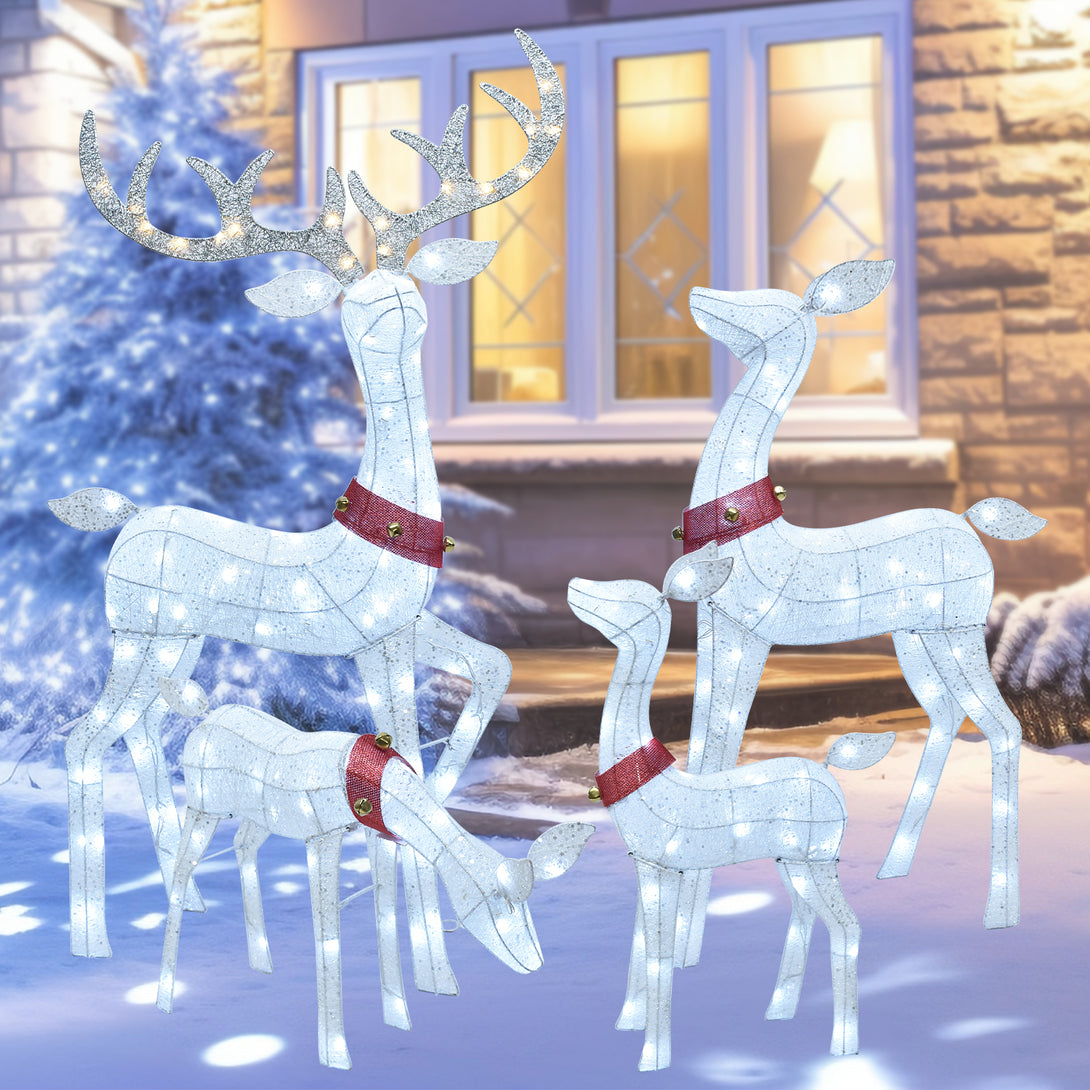
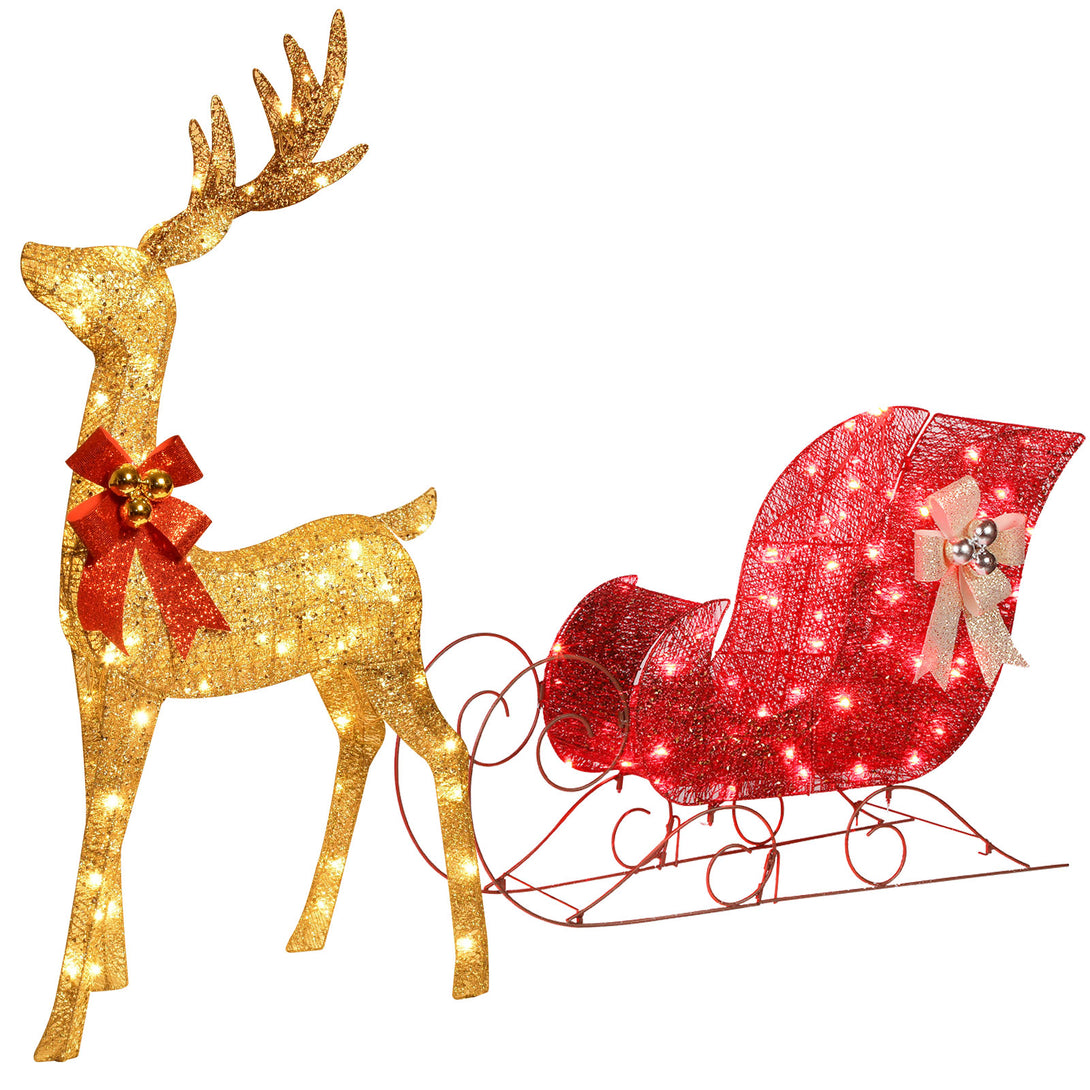
Pose is particularly easy to confuse with motion. A deer represented mid-leap can be a stationary decoration. For the distinction between physical movement and changing lights, see our animated reindeer explanation.
In HOYECHI's owner's supplier discussions, confirming the intended pose and height first helps identify which figure is being discussed. Useful pose descriptions include standing, head-down, gazing back, leaping, lying and head-up. Treat this as a way to clarify the design, not a substitute for checking the exact model's power requirements and permitted use.
Group names need the same care. “Three-piece” states a quantity, not which pieces it counts. A sleigh-related title or photograph is not enough to establish that a sleigh is supplied. Read the included-pieces list and identify each deer and accessory separately.

A real example: reading a HOYECHI product title
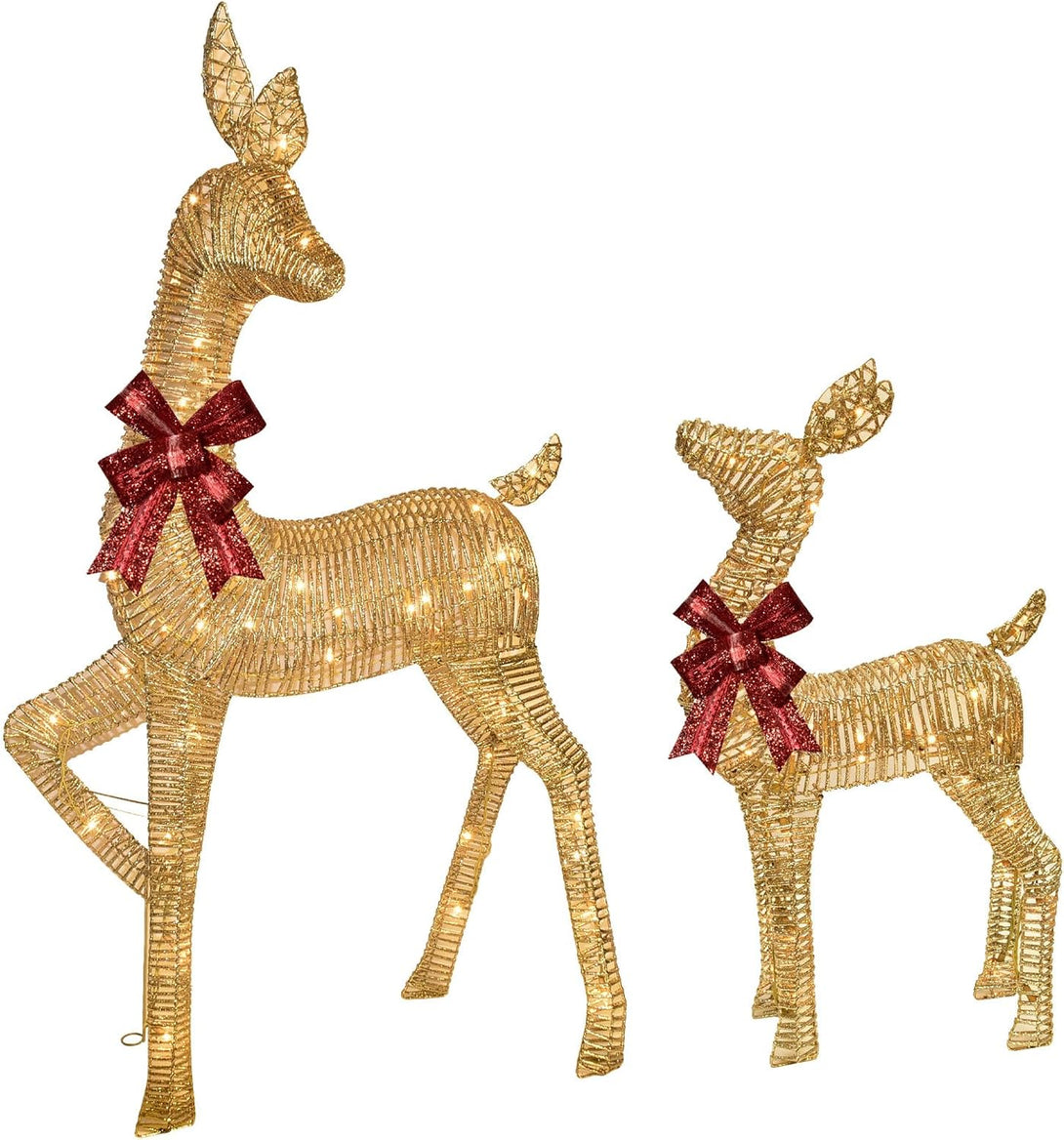
Consider the 2-Piece Lighted Christmas Reindeer Set – Gold Doe & Fawn, model HYC8036. The title contains several independent pieces of information:
- 2-piece: the listing identifies two reindeer figures.
- Doe & fawn: the product description identifies a larger doe design and a smaller fawn.
- Gold: their described appearance, not a statement that the figures are made of gold.
- Lighted: illumination is part of the decoration.
The product description also states that no sleigh is included. That clarification comes from the listing, not from a general rule about two-piece sets. Likewise, the title alone does not establish the exact body material or a movement mechanism. Do not add those specifications merely because the photo looks familiar.
Turn a category name into a clear product description
When a listing seems ambiguous, write one sentence using only confirmed information: “This is a [documented construction] deer in a [pose], supplied as [listed contents], with [stated lighting or movement].” Leave a field unknown if the listing does not answer it. An unanswered field is a useful question for the seller, not a fact to guess.
For an older model with incomplete wording, HOYECHI's owner recommends asking the supplier to check the model's bill of materials or production-process records. These are internal reference documents, not a public template or a promise that every record can be shared. The practical request is simple: confirm the exact construction and included parts against the model number, rather than naming them from a photograph.
Once the labels are clear, move on to the separate purchase decision. Our lighted Christmas reindeer buying guide covers that next step. To inspect exact listings rather than general category names, browse the HOYECHI Christmas Reindeer Collection.
Frequently asked questions
Is an LED reindeer a separate construction type?
No. LED describes the light source. You still need the product description to identify the body construction and included figures.
Does a 3D or leaping deer move?
Neither word establishes movement. “3D” describes form, while “leaping” describes a pose. Look for an explicit description of any moving part.
Can one deer belong to several categories?
Yes. Construction, pose, finish, lighting and group composition describe different attributes. Multiple labels can correctly apply to one product without contradicting each other.


