

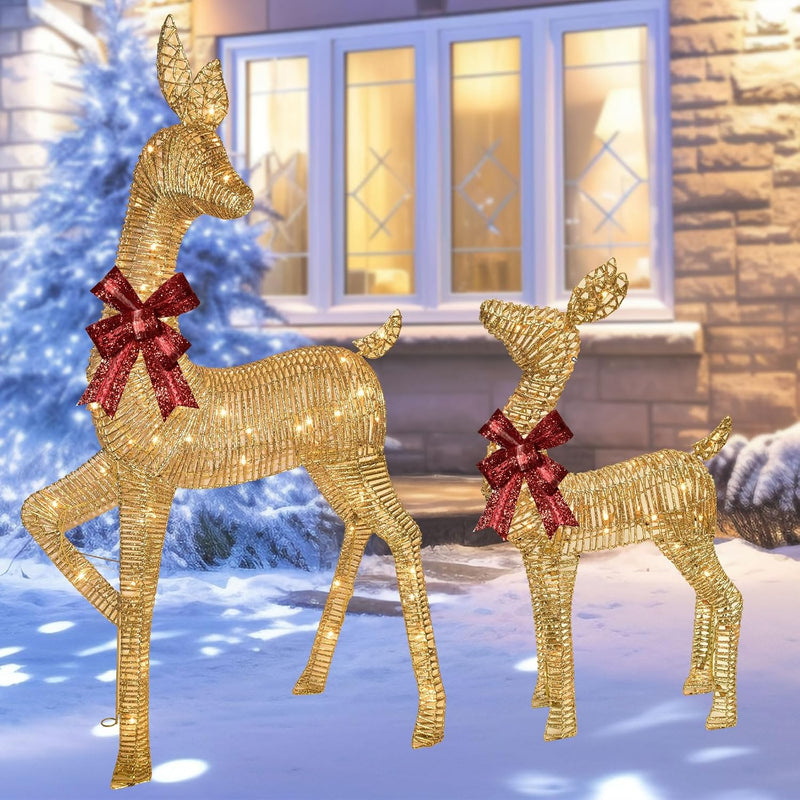
Start with both deer in the same patch beside the entrance. Place them side by side if you have more width than depth. If the area has usable depth, try setting the larger deer a little farther back and the fawn forward and to one side. From the sidewalk, look for a visible gap where the fawn's head and shoulders would otherwise overlap the larger deer.
Pick the layout that suits your yard
Side by side for a shallow strip
On a shallow strip between a porch and a path, put the doe and fawn along the same edge. Let the doe occupy the wider end. Shift the fawn toward the open end so it has a clear outline even when someone approaches at an angle. If either figure would spill into the normal route to the steps, try another patch.
A shallow stagger where you have more depth
On a lawn with a little room behind the front edge, set the doe back and place the fawn forward and off to one side. Walk to the usual street-side viewing point. If the doe’s legs or chest visually run into the fawn’s head, move the fawn sideways first. It may separate the outlines without bringing the fawn closer to the path.
Mark both footprints before settling on a spot
A deer’s height helps you picture the silhouette. Its length and width help you plan where it can sit. In the HOYECHI HYC8036 pair, the doe is listed at 28 in long × 13 in wide × 50 in high. The fawn is 16 in long × 7 in wide × 28 in high. These are individual figure dimensions. Measure the space needed for your chosen placement, the gap between the deer and the area needed for setup. The HYC8036 product page is the source for these example sizes.

- Mark the doe and fawn's separate footprints from the dimensions of your own figures. Check the door's full swing, the steps and the path you use every day.
- From a safe viewing position on the sidewalk or inside your property, check that you can tell where one deer ends and the other begins. Look especially at the fawn's head and shoulders.
- Walk the everyday approach to the door. If a column or planter hides the fawn, swap the sides or shift the whole group farther into the usable patch.
- Before setting up, check that your spot meets the chosen model’s instructions for the surface, securing and cable routing. When you can operate the display as directed, repeat the sightline checks after dark.
If neither layout leaves a clear approach and two recognizable shapes, look for a better spot or choose one separately sold figure that fits. The guide to sizing reindeer for a porch, lawn or driveway helps if you change locations. To compare one figure with a pair or a larger family, see the outdoor Christmas reindeer collection.
Frequently asked questions
How far apart should two lighted reindeer be?
Start with room to see both silhouettes from your main viewing point, then adjust from the normal approach. The viewing angle, figure sizes and exact model’s setup requirements determine the spacing.
Should the fawn go in front of the doe?
A slight forward position can work if the ground has enough depth. Put the fawn off to one side so both outlines show. In a shallow yard, start with both on the same line.
Is it better to put one deer on each side of the path?
Try the same side first if you want people to read them as one group. A split arrangement only makes sense if both sites work with the exact set’s installation and power instructions and the approach stays clear.
What if both figures look clear in daylight but blur together when lit?
Check from the usual street-side view. A small sideways move, or a slight turn of the fawn if the model permits it, can separate the lit outlines. Recheck the view on the walk to the door.
Does the same method work for two deer of similar height?
Yes. Watch where their heads, legs and antlers overlap from each view. Open a visible gap between the outlines and check both footprints before you settle on a layout.


