


A lighted wreath and a garland can give one entrance a clear centre and a surrounding frame. They can also repeat the same enclosing shape or blend into one thick band of greenery. The useful question is not simply whether the colours match: can you still enjoy what each shape contributes?
Start with the piece you already like. A wreath does not require garland to look finished, and a complete garland frame does not automatically need a wreath inside it. This guide helps you choose between the circle, the line and a combination of both.
Find the circle, the opening and the line
Use a photograph of your entrance or a simple sketch. Trace the wreath’s outside silhouette, then mark its open centre separately. Next, draw the path the garland follows or would follow. These marks describe the picture you want to see; they are not measurements or instructions for attaching anything.
Look at the sketch from the viewpoint you normally have when approaching the entrance. Can you follow the garland’s line without mistaking it for the edge of the wreath? Does the wreath retain a recognisable outer circle and an opening of its own? The answer helps distinguish three situations: a centre with a separate frame, two enclosures doing much the same job, or forms that have merged.
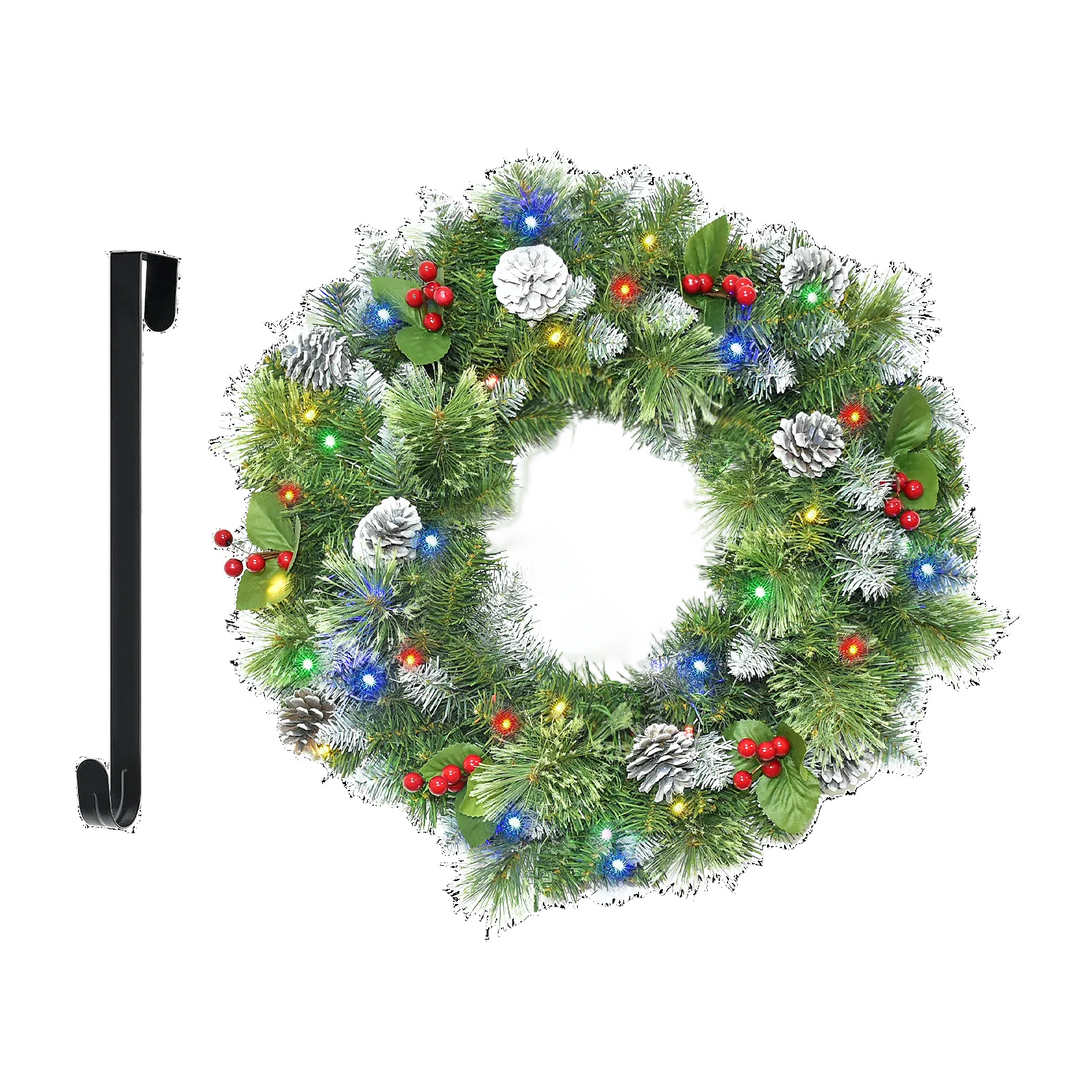
When the wreath already finishes the entrance
A wreath’s circle and open centre can make a complete composition on their own. Before adding a border, ask what you want that extra line to contribute. You might want the surrounding entrance shape to become part of the decoration. If you simply feel that a wreath ought to have a partner, keep the single piece while you compare alternatives on paper.
Hypothetical example: you like a lighted wreath on a plain door. In one sketch, a garland closely repeats the circle’s curve; in another, the wreath stands alone. If the added curve only gives you a second enclosure without a new shape to enjoy, the wreath-only version is a finished choice. Keep the favourite wreath and omit the proposed garland rather than buying a set by default.
When garland already makes the frame
Garland brings a line that can describe the entrance around it. The catalogue image below shows how a length of greenery can be laid into curves; those curves are not additional wreaths. At your entrance, judge the path as a whole before deciding it needs something inside.
Hypothetical example: a garland arrangement already gives the doorway a frame you enjoy. Draw a simple wreath inside that frame on the photograph. If you can recognise its outer ring and open centre separately from the garland, it may add a useful circular shape. If the new ring merely creates another heavy enclosure within the first, choose the garland-only plan. That outcome preserves the piece you like without leaving a supposed ‘missing wreath’ to buy.

If the greenery merges, change the drawing before the products
A merged shape is different from an uncoordinated colour scheme. The foliage may already share a colour, yet the wreath’s outer boundary disappears into the garland. Adding matching ornaments will not necessarily make that boundary easier to see.
On a second sketch, consider a different prospective garland line that would let the circle remain distinguishable. Compare that plan with versions containing only the wreath or only the garland. Choose the view in which the shapes you value are clear. If your entrance offers no suitable way to realise the alternative line, omit one piece. This is a planning exercise, not a reason to cut foliage, alter integrated lights or reposition an installed item without its own mounting requirements being resolved.
If the forms are clear, connect them with one detail
Once the circle and line remain distinct, decide whether you want them to feel more closely related. Repeat one visible cue: red berries, the appearance of pinecones or a similar foliage character. That can connect different designs without making every decoration identical.
Preserve the favourite part of the existing piece. If its pale pinecones are what you like, look for a related texture rather than replacing it merely because another wreath is sold beside a garland. The detail image shows berries and pinecones within linear greenery; it is a reference for visible decoration, not proof that these products form a matched lighting set.
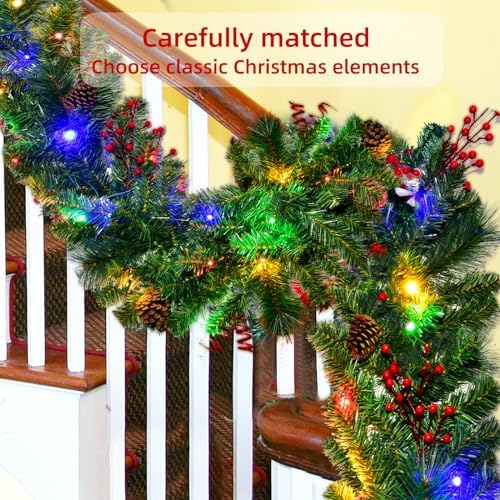
Turn the view into a keep, change or omit decision
| Starting view | Question to resolve | Keep, change or omit |
|---|---|---|
| The wreath is clear and complete; the surround is quiet | Would another line add a shape you actually want? | Keep the wreath alone unless the proposed garland contributes a distinct frame. |
| Garland already frames the entrance | Does a wreath add a readable circle or repeat the enclosure? | Keep both if the circle adds something; otherwise let garland finish the entrance by itself. |
| The wreath’s outer edge blends into the garland | Can a different planned path separate the forms? | Compare another suitable line on a sketch, or omit one piece instead of modifying it. |
| Circle and line are distinct but feel unrelated | Which visible detail would connect them? | Retain the preferred piece and echo one cue in the other; exact matching is optional. |
Shop for the role that is still missing
The illustrations come from the 24-inch lighted front-door wreath listing and the HOYECHI garland listing. Use them to compare circular and linear forms, not as a ready-made pairing or a size recommendation for your entrance. Similar-looking decorations do not establish identical light colour, synchronised controls or a shared power connection.
If your plan genuinely needs an addition, browse the wreath and garland collection for that missing role. A clear circle, a distinct line or a related decorative cue is a more useful brief than ‘buy both’. If one existing piece already gives you the composition you want, stop there.
Once you choose a prospective garland path, the separate garland length guide covers that next decision. For the wreath’s practical selection and intended setting, use the outdoor wreath buying guide. A pleasing sketch still needs product-specific suitability and installation checks before it becomes an actual arrangement.
Questions about wreath and garland combinations
Can garland alone look complete?
Yes. If its line already creates the frame you want, a wreath is optional. Add a circle only when it contributes a shape you enjoy inside that frame.
Do the wreath and garland have to match exactly?
No. When the forms are clear, one shared visible detail can be enough. A similar appearance is not proof of matching light output or compatible controls.
What if they look like one large mass of greenery?
Check whether the wreath’s outside edge and centre opening remain recognisable. Compare a different prospective garland path on a sketch with one-piece alternatives; do not try to solve the plan by cutting or altering the products.
Is there a fixed gap I should leave between them?
This guide sets no universal gap or size ratio. Use the photograph to judge the shapes, then assess the exact items and location separately for practical placement.
A coordinated entrance can be a circle, a frame or both. Keep the forms you enjoy, give any addition a distinct purpose and let leaving something out be a deliberate finish.


