


Yes—you can mix a multicolor flagpole Christmas tree with warm-white decorations. The most convincing starting point is to keep each group recognizable: let the tree retain its colorful outline while your existing warm-white lights continue to describe the porch, wreath or reindeer. You do not need to replace everything to make one new decoration feel intentional.
The choice is about the look you want. If you love a completely uniform warm-white display, a multicolor tree will deliberately change that character. If you want a playful tree within a familiar, welcoming setting, the contrast can be the reason to choose it. Here is a practical way to decide before buying more lights.
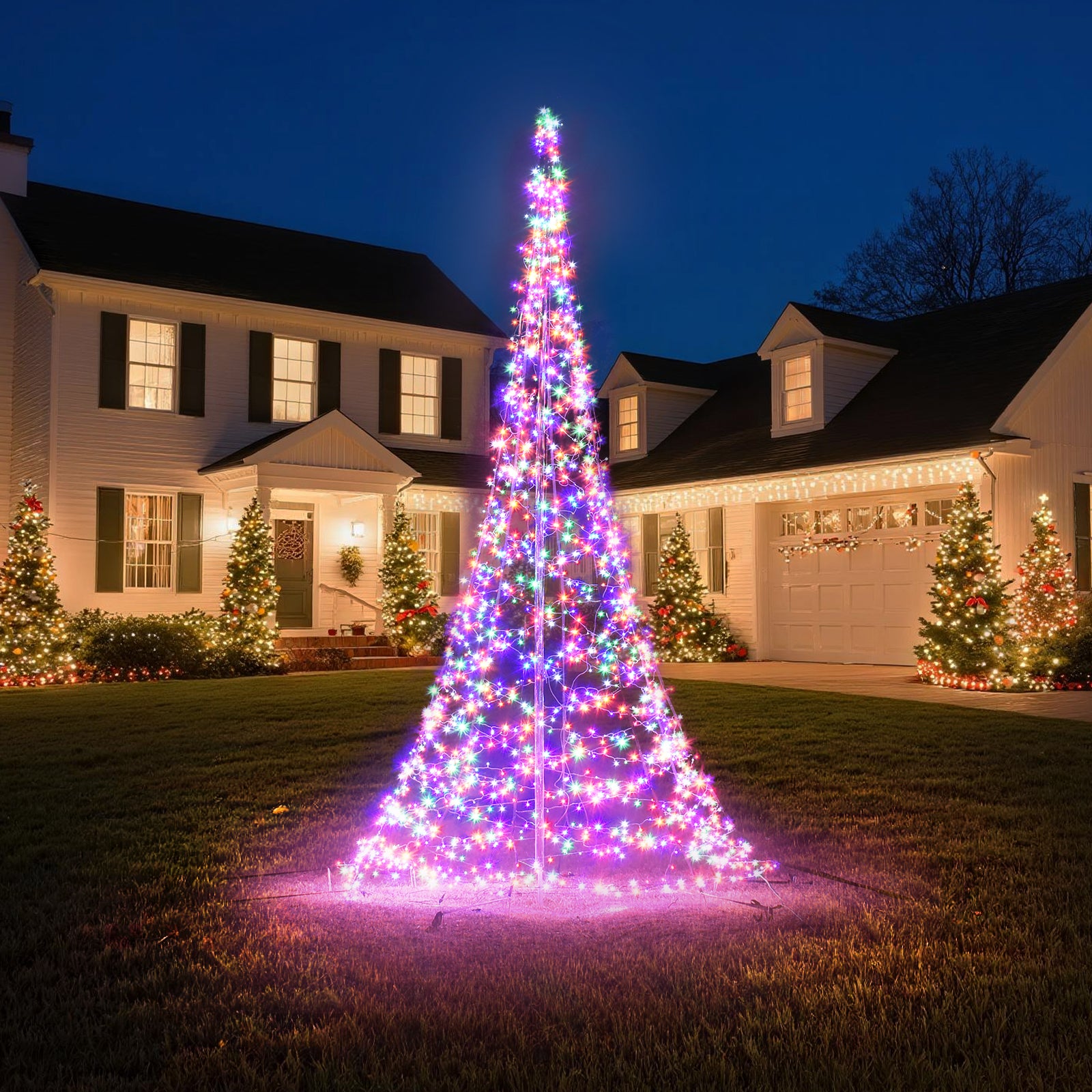
Keep two identities instead of forcing a color match
Think of warm white as the familiar part of the display and multicolor as the new seasonal expression. The two do not have to look identical. A continuous warm-white doorway can remain calm and recognizable beside a distinct colorful tree. What becomes difficult to read is a single outline crowded with unrelated extra strings.
Even the smallest model in this range, at 5 m, can make a strikingly large impression in a family yard. In this styling approach, the tree becomes the visual centerpiece: warm-white porch strings, a wreath by a window and lighted reindeer on the lawn support it, with their shapes and details echoing one another.
From a distance, the tree can become a large, striking feature in the nighttime landscape. Closer to home, the different layers come into view together, creating a sparkling Christmas atmosphere across the yard. This lets the tree’s scale bring the display together while the smaller decorations retain their own character.
For this approach, keep each decoration as supplied rather than wrapping extra lights around it to force a match. Coordinating their appearance does not mean connecting different products together. If your real concern is that two supposedly warm-white sets look different, use our guide to warm-white color differences; that is a separate matching question.
Start with the decorations you want to keep
Before selecting additions, write down what already earns its place in your display. A favorite wreath, a doorway outline or a reindeer family may matter more than making every light share a color. Give those pieces a clear role in your plan instead of treating them as things that must be replaced.
- Keep: the warm-white decoration you would miss if it disappeared.
- Connect visually: an existing bow, ribbon or painted detail whose color could echo the tree.
- Set aside for the first comparison: optional small decorations that make the color relationship harder to judge.
This small inventory prevents an unnecessary chain of purchases. Adding a colorful tree does not automatically mean buying colorful reindeer, changing the wreath or outlining the entire house again. Decide what relationship is missing before shopping for something to fill it.
Choose a relationship that suits what you already own
These are styling options, not fixed layout rules. Choose the one closest to your existing display rather than trying to use every idea at once.
| Existing warm-white feature | How the colorful tree can join it | What to avoid |
|---|---|---|
| A doorway or porch outline | Keep that continuous warm-white outline intact; read the tree as a separate colorful shape. | Turning every edge around the tree into another multicolor outline. |
| A reindeer group | Let the animals remain a recognizable warm-white group, distinct from the tree. | Threading extra colored strings over the animals to make them match. |
| A wreath with a colored bow | Keep its lighting; let the existing bow provide a small color echo. | Replacing a favorite wreath just because its light color differs. |
For example, a household with a warm-white doorway and a wreath with a red bow could keep both unchanged and consider a colorful tree nearby as a separate feature. The red detail supplies a visual connection without requiring a new matching collection. This is a planning example, not a customer installation.
Use a familiar detail to make the combination feel deliberate
A color echo can be quiet. Look at the decorations in daylight: a ribbon already on the wreath, a bow on a deer or a painted ornament may provide the link. You are repeating a visible color, not promising that a red decoration and a red LED will appear exactly the same.
Leave room for the materials to do some of the work. A textured animal figure, greenery and a light-built tree are different objects; their differences can remain visible. Adding more illuminated pieces to hide those differences often makes the original decision harder. Start with what is already there and edit before adding.
Review the combination from your normal viewing spot
- Look at your existing display first. Notice which shapes you immediately recognize and which parts you most want to preserve.
- Before purchase, use a rough sketch or a photograph to consider the new tree as a separate shape. Use product images for an impression of appearance, not an exact prediction of color or brightness.
- Once the decorations are installed according to their own instructions, view the complete display from the doorway, window or pavement where you normally enjoy it. Check whether you can still distinguish the tree, doorway and animals.
- If the combination feels busy, simplify optional small accents before replacing major pieces. Change one visual detail, then look again from the same spot.
Also look at the transition from dusk to darkness. You may prefer the relationship at one time more than another. A phone photograph is useful for remembering a decision, but exposure and white balance can change how the lights appear. Make the final styling judgment by looking at the display itself.
When keeping an all-warm-white display is the better choice
Do not force a mixed palette if the uniform warm-white look is what you enjoy most. The same applies when you already have several colorful features and cannot give the new tree a distinct identity, or when simplifying smaller details still leaves a combination you dislike.
In those situations, keeping your present display is a complete decision. There is no requirement to add a flagpole tree, upgrade to a larger one or recolor the rest of the yard. A new decoration should earn its place through the effect you want, not create a shopping list you did not need.
Considering HOYECHI’s 5 m multicolor flagpole tree
The HLT001-5 flagpole Christmas tree light kit is one specific option for the colorful part of this plan. The selected variant is 5 m (16.4 ft) high, with 1,600 multicolor LEDs and a base diameter of approximately 2 m (6.6 ft). It is a light kit for an existing flagpole; the flagpole is not included, and this 5 m variant does not include an illuminated star topper.
Choose it because you want a multicolor tree. Do not order it on the assumption that it will switch to warm white or synchronize with your existing decorations. For the practical fit, consult the flagpole-tree size guide and the installation guide before ordering; color coordination does not replace those checks.
Questions about mixing warm white and multicolor
Do all my outdoor Christmas lights need to be the same color?
No. A consistent palette is one styling approach; clearly separated warm-white and multicolor groups are another. Choose the relationship you enjoy rather than treating uniformity as a requirement.
Should I add multicolor lights to my warm-white reindeer?
For this approach, keep the reindeer as supplied. Their existing outline can complement the colorful tree without extra strings wrapped over the figures.
Will buying more matching decorations solve a busy display?
Not necessarily. First check which existing shapes are still readable, remove optional distractions and decide what is actually missing. You may find that no additional decoration is needed.
Does the 5 m HOYECHI tree change between multicolor and warm white?
The HLT001-5 variant discussed here is multicolor. This styling plan does not depend on a warm-white switching function or on shared controls with other products.
If a colorful tree fits the display you want to keep, explore the exact 5 m HLT001-5 kit. Keep the warm-white pieces you love and make the new color an intentional addition.


