

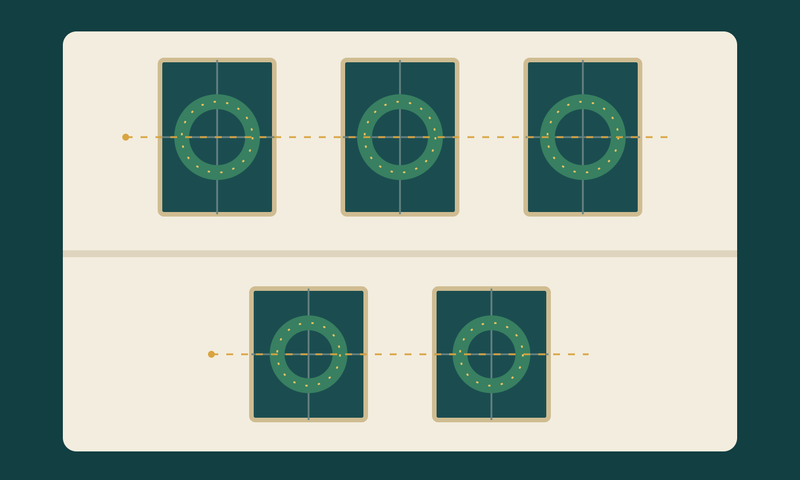
For a group of outdoor Christmas wreaths for windows, choose what you want to line up before counting how many wreaths to buy. Centres on one line, tops on one line and similar positions within individual windows create different effects. Pick a relationship within each group; the whole house does not need one rigid grid.
Start with a photo taken from your normal approach and name the visible groups: perhaps three upstairs windows and a separate pair beside the entrance. Sketch circles over the selected windows. This makes alternatives easier to compare without purchasing a wreath for every opening.
Centres or tops? Compare the same wreaths
With different diameters, aligning the centres makes a level band through the middle of the circles. The larger wreath reaches higher and lower. Aligning the top edges instead makes the upper outline level, while the larger wreath’s centre and bottom sit lower. Neither arrangement is automatically better.
Keep the circles the same sizes while comparing the two sketches. Otherwise you are changing both size and alignment and cannot see which change you prefer. For a simple reference, use the greenery circle rather than a bow tail. A long bow, irregular branch or ornament can still alter the visual balance, so judge the finished outline too.
Matching centres, tops and bottoms simultaneously is impossible for circles of unequal diameters. Choose the relationship that looks intentional instead of trying to make all three agree.
Centres aligned
Tops aligned
Different window heights need a second decision
Suppose three windows share a top edge, but the middle one is taller. A common horizontal line places all wreath centres at the same height across the façade. Placing each wreath at the centre of its own selected window area puts the middle wreath lower. One composition emphasises the row; the other follows each window.
The diagrams compare these two choices using identical circles. They are hypothetical layouts, not measurements or recommended hanging heights. Once you prefer a sketch, check each selected area separately with the window wreath size guide. A pleasing line does not establish that a product fits or can be used at that location.
Common exterior line
Centred in each window
Upper group / Lower group
Let separate floors have separate groups
An upstairs trio and a downstairs pair can each have their own reference line. They do not need to form a diagonal chain or share one vertical grid. A porch, bay or larger picture window may read as another group rather than an awkward gap to fill.
Review the sketch from a fairly straight-on view and from the approach you actually use. A phone photograph taken at an angle can distort parallel lines. Use it to compare compositions, not to establish installation measurements. Decide which view should show the decorated face with our guide to viewing window wreaths from both sides.
Turn the sketch into a shopping list
Record five things for each selected position: group name, chosen window area, role in the sketch, candidate model after checking fit, and quantity. For example, an upper trio might share a centreline while a lower pair follows its own windows. That is two design decisions, not an instruction to buy five wreaths.
For an appearance reference, the HOYECHI HYC706-24 product gallery shows green foliage, berries and pinecones in a paired entrance composition. Use the image to compare repeated circular shapes and decoration. It does not establish matching dimensions in the scene, attachment methods or suitability for an exposed window.
Before ordering, confirm the selected model’s finished dimensions, intended use and placement instructions for every position. Visual alignment and actual mounting are separate decisions. Keep an unsuitable window empty or revise the group rather than forcing the product to fit.

Frequently asked questions
Do all window wreaths have to hang at the same height?
No. Use a consistent relationship within a recognisable group. Separate floors or architectural sections can follow their own lines. “Same height” should mean a defined reference, such as the circle centre, rather than an unspecified part of the decoration.
Should I align the centres or the tops?
Compare both with the same circles in a photo sketch. Centres create a shared middle line; tops create a shared upper edge. With equal diameters the results coincide, but mixed diameters make the difference visible.
Can different diameters still look coordinated?
Yes. Their centres or tops can align deliberately even though the other edges differ. Keep the chosen reference clear, and confirm each finished product fits its own selected area.
What if the window tops match but the heights do not?
Choose between a common exterior line and comparable placement within each window. Centring each wreath inside a taller window moves its centre lower; that is a different composition, not necessarily a mistake.
Must upstairs wreaths sit directly above downstairs wreaths?
No. Treat a recognisable upper row and lower pair as separate groups. Repetition can come from the circles or decoration without forcing all windows into one grid.
Does a bay window need a wreath on every pane?
No. Compare one selected area with a small group before deciding. The angled panes change how the circles overlap from the approach, so evaluate the whole bay rather than automatically counting every pane.
Can I leave one window undecorated?
Yes. An empty window can separate groups or give a focal window more space. Check whether the omission looks intentional from the usual viewing point; complete coverage is not the goal.
Do equal ribbon lengths guarantee alignment?
No. Different starting points, wreath sizes or attachment arrangements can produce different centre heights. Ribbon length alone is not a visual reference or a mounting specification.
Why does an apparently level row look tilted in a phone photo?
Camera angle and perspective can change the apparent lines. Compare another view with the camera more square to the façade. Do not adjust an installation solely to make one angled photograph look level.
With the selected positions settled, browse HOYECHI wreaths and garlands to compare the missing pieces. Buying only the positions that improve the group can make a clearer display than decorating every window.


