

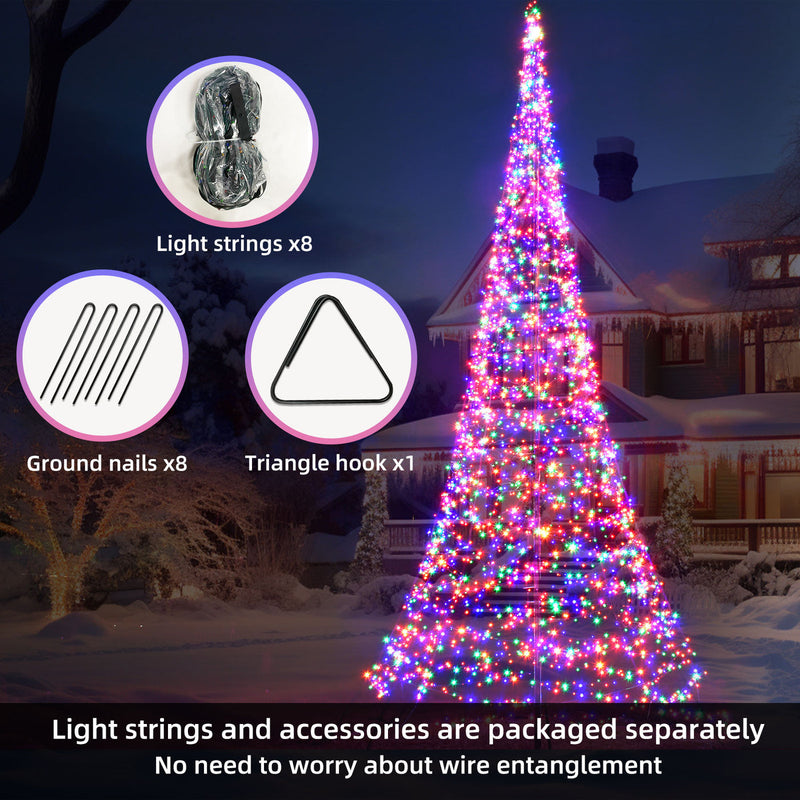
Possibly. Before ordering a flagpole Christmas tree light kit, confirm that your pole permits the attachment for the kit you want and can raise it to the required height. A flag that goes up smoothly answers a narrower question: the mechanism works with your flag. Start with your pole’s model number and the instructions for your chosen tree size. The HOYECHI kit comes without a flagpole.

What connection does the HOYECHI kit need?
HOYECHI’s general illustration shows a working flag rope running through a pulley at the top of the pole. A triangular hanging ring connects to the rope, and the light modules hang from that ring. Look at the illustrated top connection in the installation guide to see which part the pole would need to raise. Ask for the current instructions for your exact kit before deciding that your hardware matches the picture.
Use the model code in your inquiry: HLT001-5 for the 16.4 ft (5 m) tree, HLT001-7 for 23 ft (7 m), or HLT001-10 for 33 ft (10 m). The HOYECHI kit listing identifies the three options. On the pole side, check a receipt, installer’s paperwork or a label readable from the ground for the make and model.
Use the model code to check the hanging hardware included with your kit.
Which lifting system does your pole have?
Use what you already know from raising the flag and what you can see while standing on the ground. A halyard is the rope or cable used to raise a flag. Leave enclosed mechanisms closed. You can complete this check without climbing, hanging a test weight or changing any hardware.
| What you notice | What to look up | If something is unclear |
|---|---|---|
| External halyard. A line runs outside the mast and ties off at a cleat. | Does the manual permit the connection the tree kit uses? How high can that fitting travel? | Ask the pole maker about that exact attachment, even if the rope and pulley resemble the kit illustration. |
| Internal halyard. The flag line runs inside the mast. | Find the model diagram showing the lifting system and any permitted external connection. | A closed access panel tells you little about what is inside. Send the model reference instead of guessing from the panel. |
| Telescoping pole. The flag rises as the mast sections extend. | Does the documentation describe a permitted way to raise this kit’s top fitting? | If the manual only describes flag clips, ask the pole manufacturer about the proposed use before ordering. |
What about the base and wind exposure?
Note the installed base or ground sleeve if you have the original installation record. From the ground, record any visible lean, movement or damage. A tidy base cover cannot tell you the footing dimensions or its condition below ground. If the condition or suitability is uncertain, pause the order and ask a qualified local installer to review the actual installation.
If the pole manual lists a wind limit for a particular flag or an empty mast, ask whether its conditions cover the proposed tree, its hanging ring and its anchors. Give the mast manufacturer the kit information and request the conditions for that pairing. Ask HOYECHI for any documented limits for the kit itself. Leave the question open if neither set of instructions addresses the combination.
Two front-yard examples
The rope looks right, but its travel is uncertain. Suppose your fixed mast has an external rope and you can identify the model. The pole maker has confirmed that the selected kit’s attachment is permitted. The only height you have, though, is the overall mast height on the receipt. The pole tip may sit above the pulley. Ask how high the permitted fitting can actually travel. If that position meets the kit instructions, you can move on to checking the site. If it falls short, set that kit aside for this pole.
The pole is tall enough on paper, but the attachment is undocumented. Suppose a telescoping mast extends to 25 ft and you want a 23 ft kit. The instructions describe clipping a flag to the sliding sections. There is no mention of raising a separate ring. Leave the decision open and give the pole maker the kit’s fitting details. If the maker rules out that use, cross off this pairing. Buying the smaller kit would still leave the attachment question to resolve.
What to send, and whom to ask
Keep one note with the pole make and model, kit code, the relevant manual page and the usable lifting height if known. Add a ground-level photo of the visible rope, clips or pulley if it helps explain your question. A photo can identify a part; it cannot establish the strength of the mast.
- Ask HOYECHI: “I’m considering HLT001-7. Which top fitting and lifting arrangement does its current manual specify, and where does the fitting need to sit?”
- Ask the pole manufacturer or a qualified installer: “Here is my mast model and the kit fitting. Is this use permitted on my model, and can that fitting reach the specified position?”
Keep the replies with the model instructions. Once both answers are clear, use the front-yard fit checklist to measure your ground space and shortlist tree sizes. The flagpole tree buying guide covers the other pre-order questions.
Once the attachment is confirmed, measure the usable ground around the pole to check the base, access and stake positions.
If reindeer will share the yard, keep their positions clear of the pole, base and setup route. Mark and compare three- and four-reindeer layouts in the space left for the figures.
Once the pole and setup route are confirmed, compare the deer’s height from the sidewalk to find a position clear of the pole and the work area.
Frequently asked questions
Can the flagpole be taller than the finished tree?
Yes. What matters here is whether the permitted fitting can reach the kit’s required position. A decorative finial or bare pole showing above the tree does not answer that question.
What if I inherited the pole and have no paperwork?
Look for a ground-level model label or ask the previous owner or installer for the original records. If the pole and its permitted use still cannot be identified, leave compatibility unconfirmed.


